
Create Walmart Instance In Odoo
To create your Walmart instance in Odoo, navigate to and click on New.
Choose a meaningful name for your Instance (e.g.
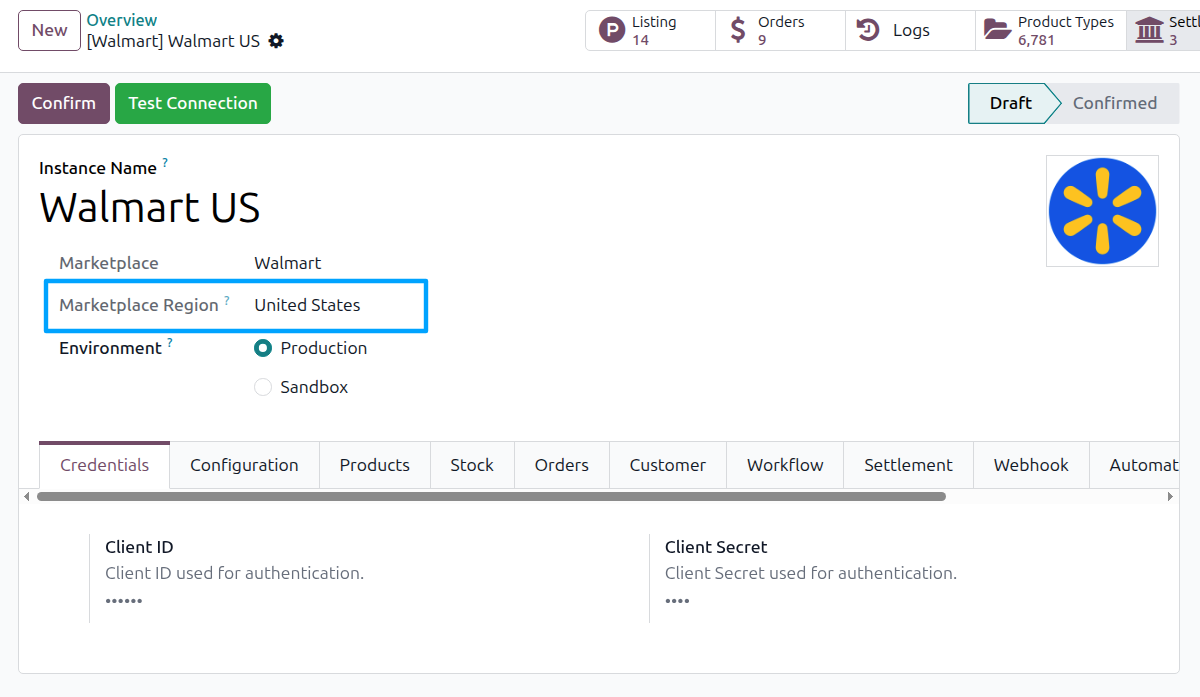
Walmart US), and selectWalmarton Marketplace.Select the Marketplace Region: United States, Canada, Mexico, or Chile. This tells the connector which Walmart marketplace the instance belongs to.
Choose the Environment: Production or Sandbox.
On the Credentials tab, fill in the Walmart API credentials. Follow the Generate Walmart API Credentials guide to create them in Walmart Seller Center.
Important
The Marketplace Region cannot be changed after the instance is saved. Choose it carefully. If you picked the wrong region, create a new instance with the correct one.
Important
Walmart does not provide a Sandbox environment for Canada. If you select Sandbox on a Canadian instance, Odoo blocks the save with the message “Walmart does not provide a sandbox environment for Canada. Please switch the environment to Production.” See Walmart Supported Marketplaces.
Tip
A guided Quick Setup wizard is also available for first-time setup and walks you through these same steps.
Let’s begin with the instance configuration process for the Walmart Odoo Connector. By following the configurations below you’ll be able to set up and customize the integration according to your business needs. Let’s get started!
Credentials
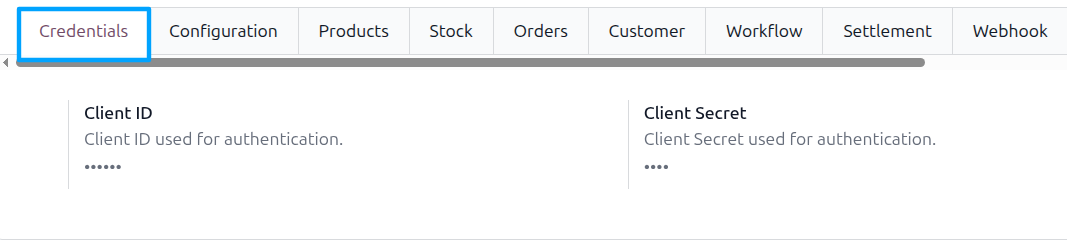
Client ID: Client ID used for authentication.
Client Secret: Client Secret used for authentication.
Both fields are required and are masked once entered. They become read-only after the instance is confirmed.
Important
The credentials must belong to the same Walmart marketplace you selected in Marketplace Region. Credentials created for one marketplace do not authenticate against another.
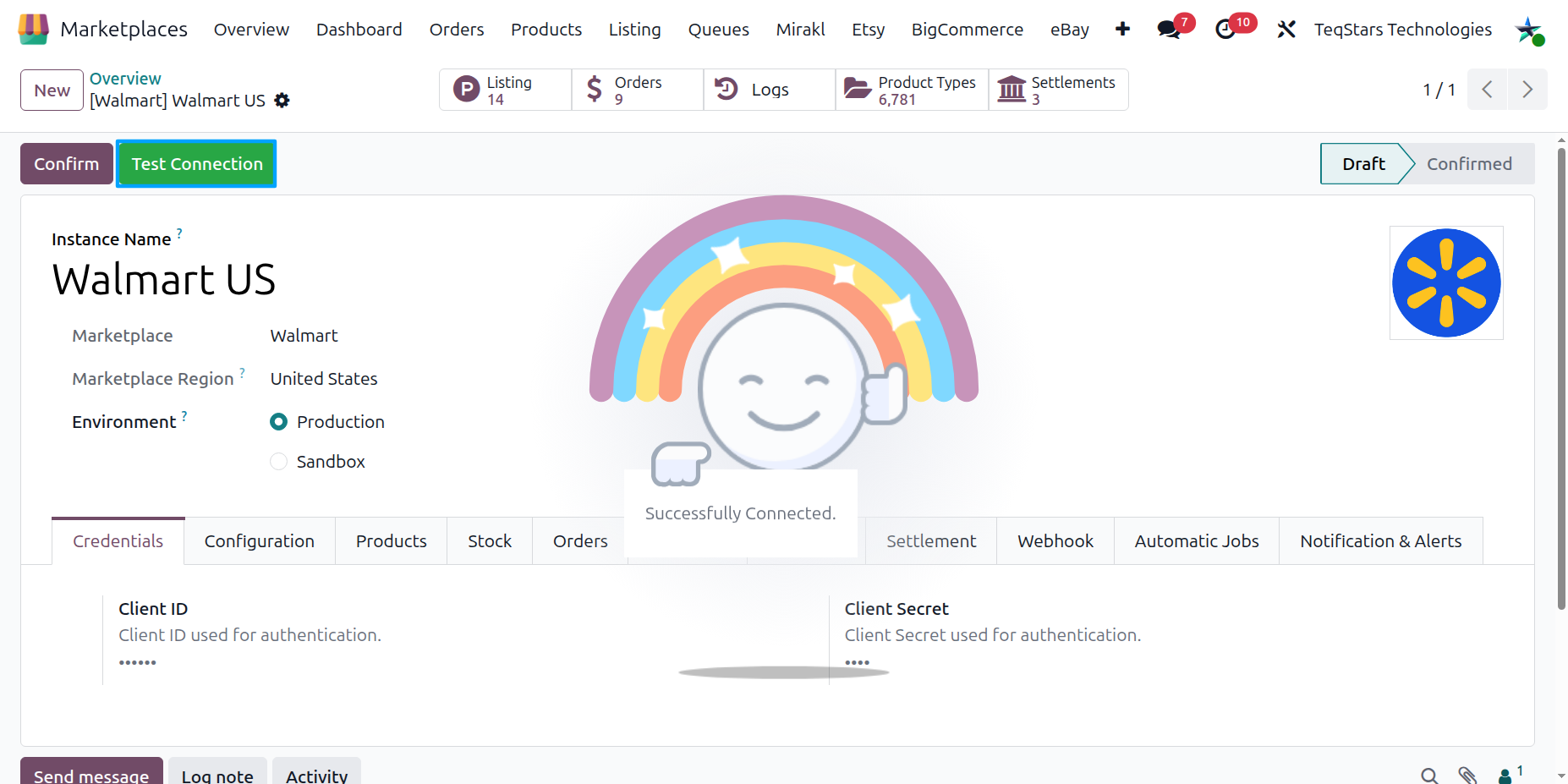
Once the credentials are filled in, use the Test Connection button in the header to verify them. On success Odoo confirms with Successfully Connected.
Configurations
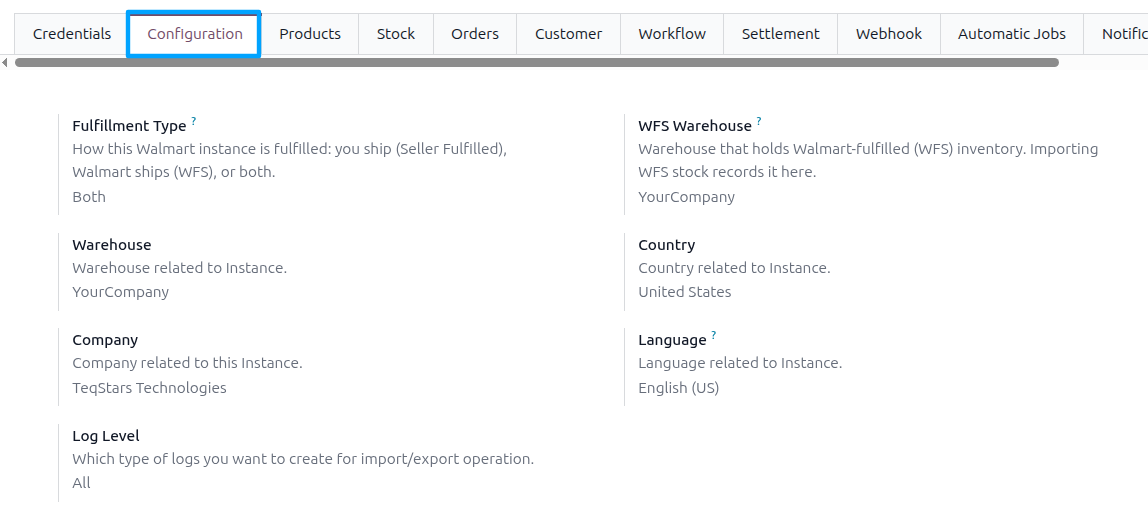
Warehouse: This warehouse will act as the default warehouse for the instance. For seller-fulfilled orders it is the warehouse you ship from, and the warehouse whose stock is exported to Walmart.
Country: Country related to the instance.
Company: Choose the company related to the instance.
Language: Language related to the instance.
Log Level: Choose which type of log level you would like to have. You can choose between
All,Success, orError. The system will create logs for each marketplace operation. To view the logs, navigate to .Queue Batch Limit: Defaults to 100 records. We do not suggest changing this.
Note
To modify the Queue Batch Limit, activate the developer mode and navigate to and click on the Configuration tab.
Fulfillment Type: How this Walmart instance is fulfilled. Choose between:
Seller Fulfilled: you hold the stock and you ship the orders. You acknowledge these orders, export their tracking, and handle their returns yourself.
WFS (Walmart Fulfillment Services): Walmart holds the stock in its fulfillment centers and ships and returns the orders for you. WFS orders are marked acknowledged in Odoo on import (there is nothing for you to confirm), and you do not export tracking for them.
Both: you run both models on the same Walmart account.
This choice decides which operations and which scheduled actions the instance gets, so set it before confirming.
WFS Warehouse: Warehouse that holds Walmart-fulfilled (WFS) inventory. Importing WFS stock records it here. This field appears, and is required, when the Fulfillment Type is
WFSorBoth.Tip
Use a warehouse dedicated to WFS, separate from the one you ship from yourself. WFS stock is physically held by Walmart, so mixing it with your own stock overstates what you can actually ship.
Product Configurations
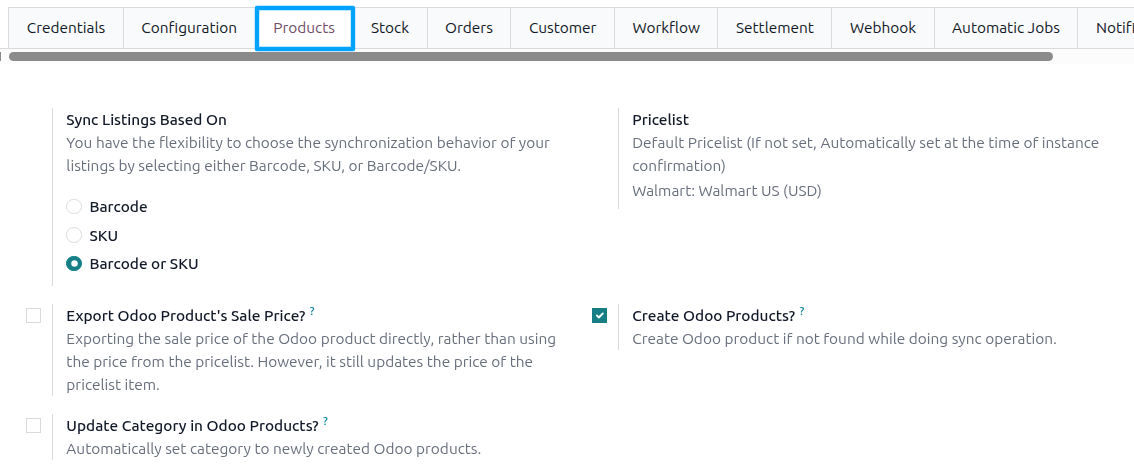
Sync Listings Based On
Decides how the connector matches a Walmart item to a product in Odoo. You can choose between
Barcode,SKU, orBarcode or SKU.Barcode: the Walmart item is matched to the Odoo product with the same barcode. Walmart supplies the barcode as the item’s GTIN or UPC.
SKU: the Walmart item is matched to the Odoo product with the same internal reference.
Barcode or SKU: the connector matches on either value.
Choose the option that matches how your Odoo catalog is actually keyed. If your products have reliable internal references but no barcodes, use
SKU.
Pricelist
Pricelist refers to a pricing configuration that determines the prices of products during the product sync operation between Walmart and Odoo. When prices are exported during synchronization, this pricelist is used to set the appropriate prices.
Use a pricelist in the currency of your marketplace. See Walmart Supported Marketplaces for the currency of each marketplace.
Export Odoo Product’s Sale Price?
When exporting Odoo products, the standard behavior is to export the prices based on the pricelist configured in the Instance. However, if you want to export the product’s sale price directly, bypassing the pricelist, you can customize the export functionality by enabling this option.
Create Odoo Products?
Enabling the Create Odoo Products? option allows the Walmart Odoo Connector to automatically create new products in your Odoo catalog when a matching product is not found. The match is made using the Sync Listings Based On setting.
Tip
If you already have existing products in your Odoo ERP system, it is not recommended to enable the Create Odoo Products? option in the Instance.
Update Category in Odoo Products?
This ensures that when a new product is added to the Odoo ERP system, it is automatically set to the category received from Walmart.
Stock Configurations
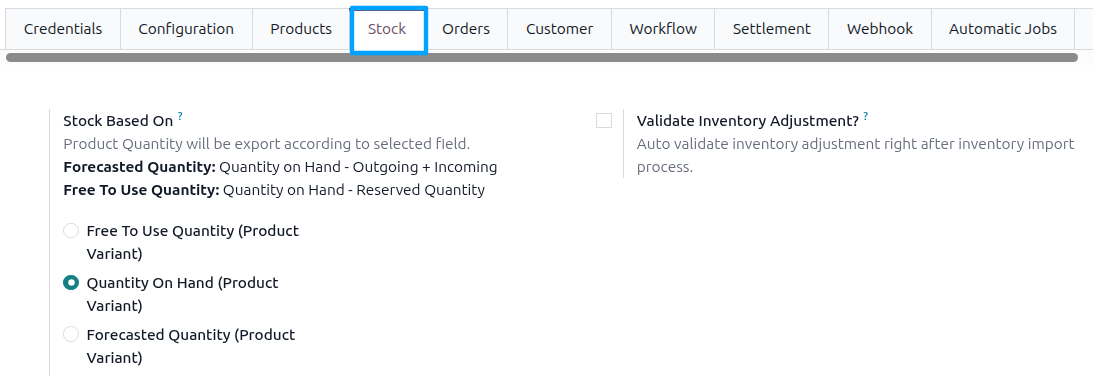
Stock Based On (visible to Odoo administrators only)
When exporting Inventory from Odoo to Walmart, you can choose
Free To Use Quantity,Quantity On HandorForecasted Quantityconfiguration based on your requirements, ensuring accurate inventory management between Walmart and Odoo.Tip
Forecasted Quantity: Quantity on Hand - Outgoing + Incoming
Free To Use Quantity: Quantity on Hand - Reserved Quantity
Validate Inventory Adjustment?
When enabled, the inventory adjustment created while importing stock from Walmart is validated automatically instead of being left in draft.
Orders Configurations
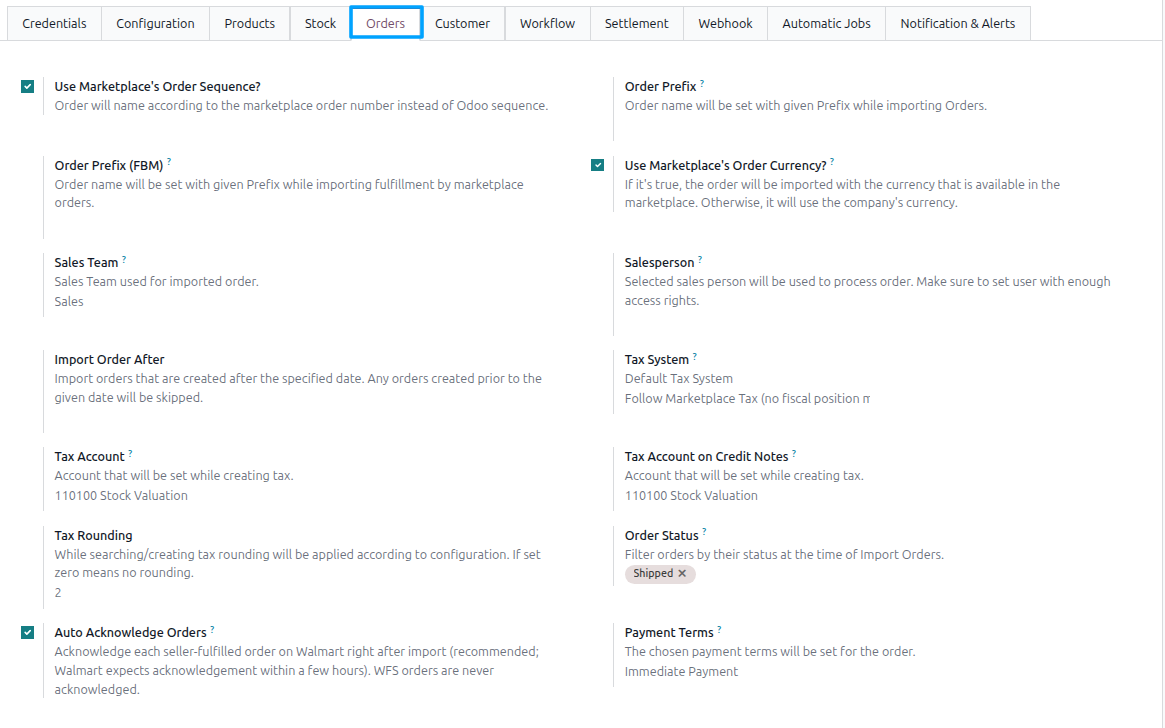
Order Status
Filter orders by their status at the time of Import Orders. Only orders currently holding one of the selected statuses are imported.
The field is required, and a new instance starts with Created selected.
Status
Meaning
Availability
Created
The order was placed and is waiting to be acknowledged.
All markets
Acknowledged
You confirmed to Walmart that you received the order.
All markets
Shipped
The order has been shipped.
All markets
Delivered
The order has been delivered to the customer.
All markets
Cancelled
The order was cancelled.
All markets
On Hold
The order is on hold.
Mexico
Note
All six statuses can be selected on any instance, but On Hold is only used by the Mexican marketplace. Selecting it elsewhere does no harm, it is simply ignored.
Important
Because the default is Created only, a new instance imports newly-placed orders and nothing else until you change this.
This matters most if you use WFS. Walmart picks, packs and ships WFS orders for you, so those orders move to Shipped and then Delivered on Walmart’s side without Odoo doing anything. If Shipped and Delivered are not selected, Odoo never pulls those updates back and the orders look stuck. Add them to the filter on any instance that uses WFS.
Auto Acknowledge Orders
Acknowledge each seller-fulfilled order on Walmart right after import. Walmart expects orders to be acknowledged within a few hours, so leaving this enabled is recommended. It is enabled by default.
WFS orders are never acknowledged, so this option is hidden when the Fulfillment Type is
WFS.If you turn it off, acknowledge orders yourself with the Acknowledge Orders operation. See Acknowledge Walmart Orders.
Payment Terms
The chosen payment terms will be set for the order.
Use Marketplace Order Sequence?
This feature allows you to name orders in Odoo based on the Walmart order number rather than using the default Odoo sequence. This ensures that the order names in Odoo correspond directly to the order numbers generated by Walmart, providing consistency and easier cross-referencing between Odoo and Walmart.
Order Prefix
This feature allows you to specify a prefix that will be added to the names of imported orders. When importing orders from Walmart to your Odoo ERP system, the connector will automatically set the order name with the given prefix. This helps to easily identify and distinguish the imported orders in your Odoo system.
This prefix is used for the orders you fulfill yourself.
Order Prefix (Fulfilment by Marketplace)
The prefix used for orders fulfilled by Walmart, so WFS orders can be told apart from your own at a glance.
Use Marketplace Order Currency?
When enabled, imported orders are assigned the currency used on Walmart. In this case, the order currency will match Walmart’s currency.
If the feature is disabled, the company’s default currency will be used for the imported orders.
Sales Team
By configuring this feature, you can ensure that all imported orders from Walmart are automatically assigned to the specified default Sales Team in Odoo.
Salesperson
Select a salesperson who will be responsible for processing the orders received from Walmart. It is important to ensure that the assigned user has sufficient access rights in Odoo.
Import Order After
This feature allows you to import orders from Walmart that were created after a specific date. By setting this date, any orders created before the specified date will be skipped during the import process.
Tax System
The tax system in the Walmart Instance offers three options for handling taxes when importing orders from Walmart:
Odoo’s Default Tax Behaviour (Taxes will be taken from Odoo Product):
With this option selected, Odoo will use the tax information defined on the Odoo products and related fiscal rules. When importing orders from Walmart, the connector ignores Walmart tax lines and applies the taxes configured on the corresponding Odoo products. This keeps tax calculation fully aligned with your Odoo tax configuration.
Follow Marketplace Tax (no fiscal position mappings):
With this option, the connector follows the tax amounts coming from Walmart. For each tax in the Walmart order, Odoo looks for a matching tax; if it does not exist, a new tax can be created and linked to the configured Tax Account fields. The resulting Odoo taxes from Walmart are applied directly on the order and shipping lines without applying any fiscal position mappings.
Follow Marketplace Tax and applies fiscal position mappings:
This option also starts from the taxes provided by Walmart, creating or reusing matching Odoo taxes as needed. After determining the Odoo taxes based on Walmart tax lines, the connector applies the fiscal position of the order to remap those taxes before posting them on the order lines. This lets you respect Walmart tax amounts while still using Odoo fiscal position rules for accounting and reporting.
Tax Account
This allows you to specify the account to be associated with a tax when it is created in Odoo. This account is used for recording tax-related transactions and ensures accurate tracking and reporting of tax amounts within your Odoo ERP system.
Tax Account on Credit Notes
This allows you to specify the account to be associated with a tax on credit notes when it is created in Odoo.
Tax Rounding
When the Tax Rounding is enabled and set to zero, no rounding will be applied. This feature ensures that tax calculations are accurate and aligned with your specific tax regulations and requirements.
Delivery Product (Only visible in developer mode)
This allows you to define a specific product in Odoo that will represent the shipping charges on orders imported from Walmart.
Fee Product (Only visible in developer mode)
Walmart Fee order lines will be imported with this product. Only a Service type product can be selected.
Create Single Invoice? (Only visible in developer mode)
When enabled, the invoice is created only when all products in the order are ready to be invoiced. This ensures a single consolidated invoice instead of multiple partial invoices.
Customer Configurations
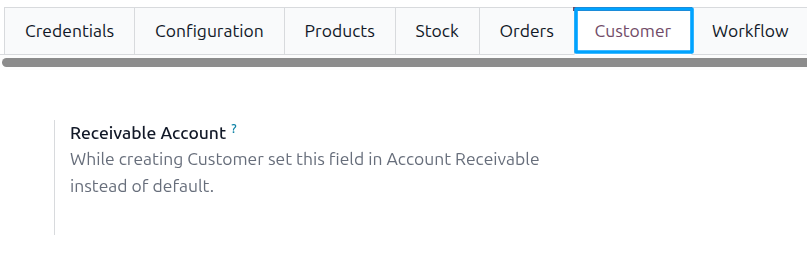
Receivable Account
This allows you to specify the default account for receivables when creating customers. By setting this field to Account Receivable instead of the default account, you ensure that the receivable transactions, such as invoices and payments, associated with the customer are correctly accounted for in the Odoo ERP system.
Workflow Configurations
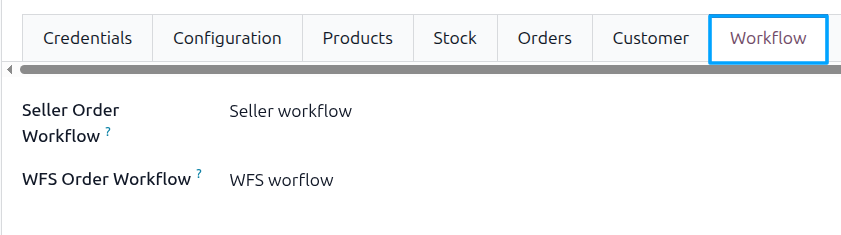
Workflow is a configuration setting used in the Walmart Odoo Connector that enables the automatic processing of orders imported from Walmart. This workflow automates various actions, including confirming orders, creating invoices, validating invoices, and registering payments.
Because seller-fulfilled and WFS orders are handled differently, a Walmart instance has a separate workflow for each.
Seller Order Workflow
Applied to orders you fulfill yourself. Required when the Fulfillment Type is
Seller FulfilledorBoth.
WFS Order Workflow
Applied to orders fulfilled by Walmart. Required when the Fulfillment Type is
WFSorBoth.WFS orders are already picked, packed and shipped by Walmart before they reach Odoo, so this workflow normally validates the delivery rather than leaving it open.
To learn more about the details and configuration options of the Marketplace Workflow, please refer to the following link: Configure Marketplace Order Workflow
Settlement Configurations
Note
Settlement reports are available for the United States marketplace only. On instances configured for Canada, Mexico, or Chile this tab is not shown. See Walmart Supported Marketplaces.
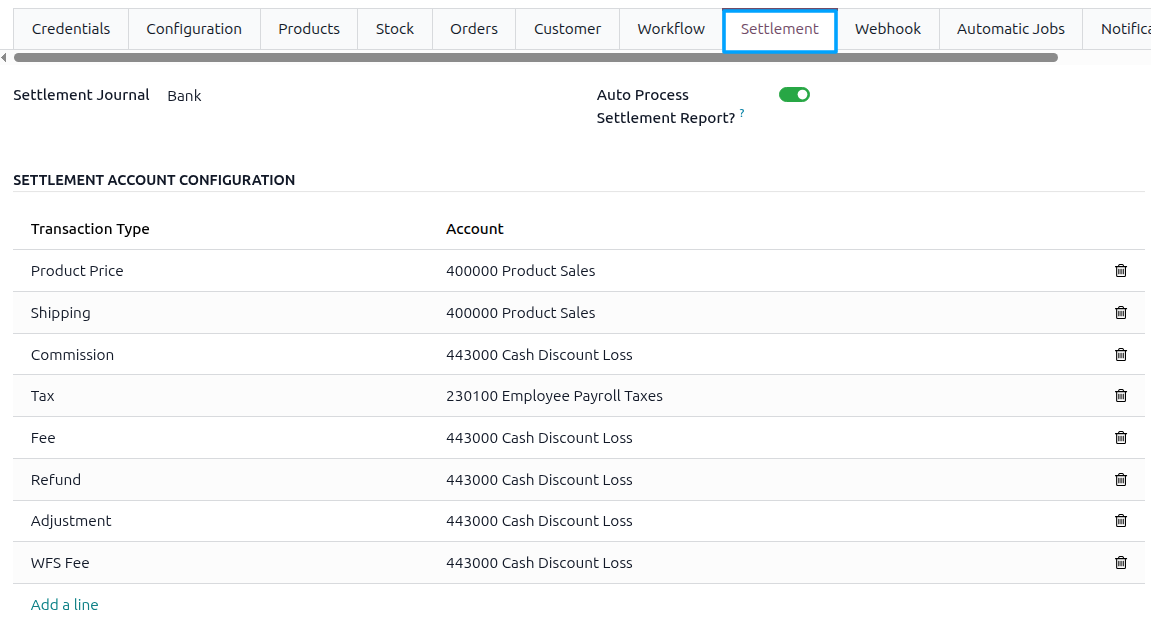
Settlement Journal
The bank or cash journal used when the settlement report is posted. Only bank and cash journals can be selected. The remaining settlement settings appear once a journal is chosen.
Auto Process Settlement Report?
System will automatically process/reconcile settlement report with invoice at the time of import settlement process.
Note
Auto Process requires the Accounting application from Odoo Enterprise. In Odoo Community, enabling it is refused with “Auto Process Settlement Report is not supported in Community.”
Settlement Account Configuration
Maps each Walmart Transaction Type to the Odoo Account it is posted to. Add one line per transaction type you expect to receive.
See Import Walmart Settlement Reports for how the reports are imported and reconciled.
Webhook Configurations
Webhooks let Walmart notify Odoo as things happen, instead of Odoo asking periodically at the next scheduled import. They complement the scheduled actions; they do not replace them.
Note
Webhooks are available for the United States marketplace only. On instances configured for Canada, Mexico, or Chile this tab is not shown. See Walmart Supported Marketplaces.
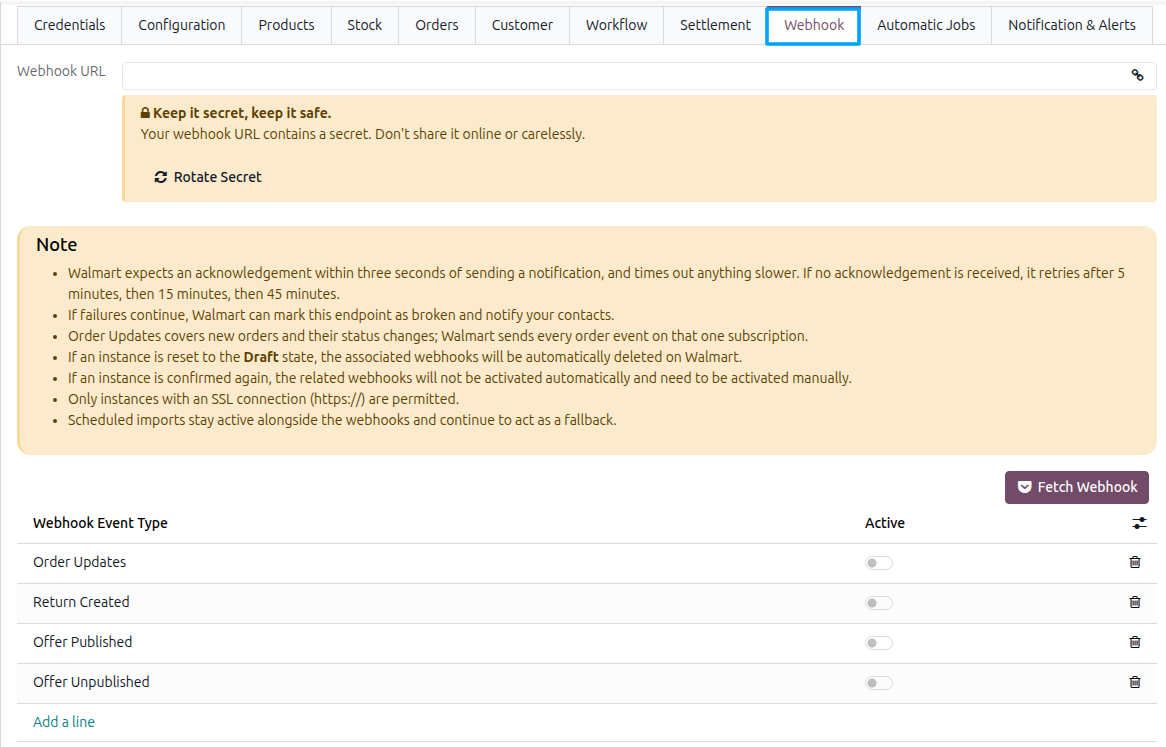
Webhook URL
The address Walmart sends notifications to. It is generated once the instance is confirmed, and can be copied with the button beside it.
Warning
Keep it secret, keep it safe. Your webhook URL contains a secret. Don’t share it online or carelessly.
Walmart Webhooks
The events this instance subscribes to. Each line shows the Webhook Event Type and whether it is Active. Ticking Active registers the subscription with Walmart immediately; clearing it removes the subscription. The Subscription ID column shows Walmart’s own reference once registered.
The available events are Order Updates (covers new orders and their later status changes), Return Created, Return Invoiced, Return Delivered, Offer Published and Offer Unpublished. Return events fetch the full return from Walmart, and offer events update the listing to whatever the notification reports.
Three buttons in the header manage the subscriptions:
Fetch Webhook reads your live subscriptions from Walmart and adds anything Odoo is missing.
Rotate Secret generates a new secret, updates the URL, and re-registers your active webhooks. Use it if you think the current URL has been exposed.
Delete Webhook removes every webhook for this instance, in Odoo and on Walmart. It is only visible in developer mode.
Automatic Jobs Configurations
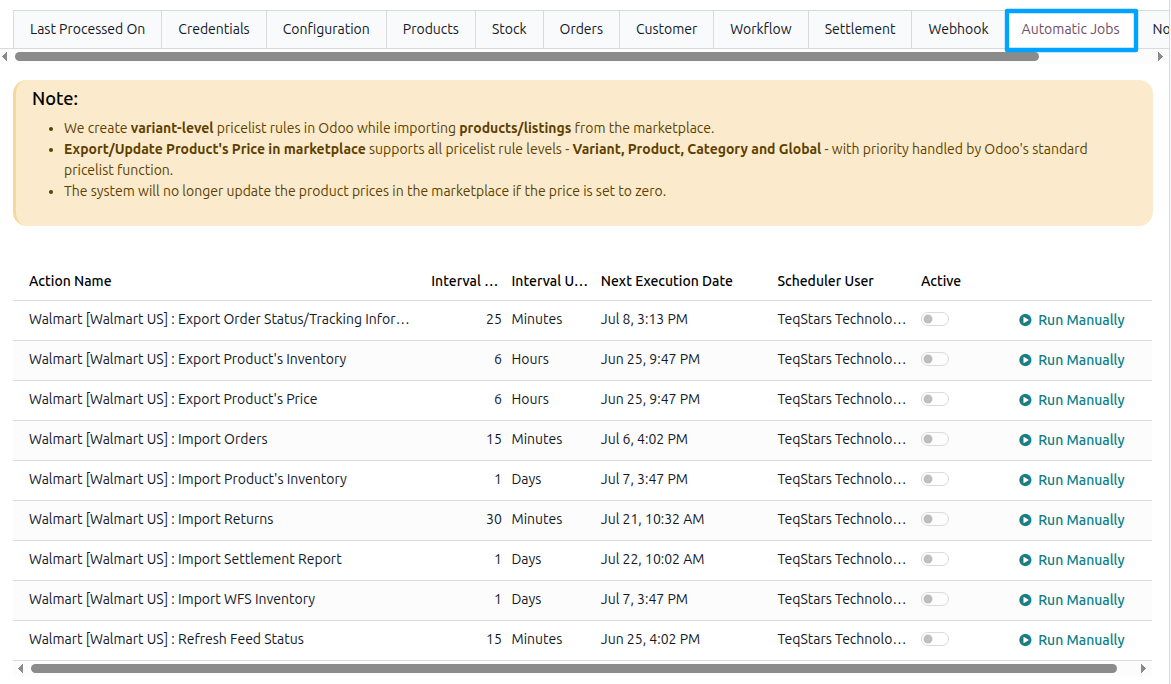
Automatic Jobs Configurations allow for the automation of various tasks related to exporting and importing data between Walmart and Odoo. You can configure Interval Number, Interval Unit, and Active for each job.
The jobs are created as soon as the instance is saved, before you confirm it. Which jobs you get depends on the marketplace and the fulfillment type of the instance.
Note
This tab is only visible to users with Odoo administrator rights.
Important
The scheduled actions are created inactive. Nothing runs automatically until you switch on the Active toggle for each job you want to use.
Each job is named after its instance, in the form Walmart [<instance name>] : <job>. Which jobs an
instance receives depends on its marketplace and fulfillment type:
Job |
Interval |
Created for |
|---|---|---|
Refresh Feed Status |
15 minutes |
Every instance |
Export Product’s Price |
1 day |
Every instance |
Import Orders |
15 minutes |
Every instance that receives orders |
Export Product’s Inventory |
30 minutes |
Instances that hold their own stock |
Import Product’s Inventory |
1 day |
Instances that hold their own stock |
Export Order Status/Tracking Information |
25 minutes |
Instances that hold their own stock |
Import Returns |
30 minutes |
Instances that hold their own stock |
Import WFS Inventory |
1 day |
Instances that fulfill through WFS |
Import Settlement Report |
1 day |
United States instances only |
“Instances that hold their own stock” means the Fulfillment Type is Seller Fulfilled or Both.
A WFS instance does not run these jobs because Walmart manages the stock, ships the orders, and handles
the returns. Keep Refresh Feed Status enabled when using any export job. Otherwise, the export stays
in progress and its result is not recorded.
Note
It’s important not to schedule all your processes to run at the same time interval because it can consume a significant amount of your system resources. Instead, it’s recommended to leave a gap between them. This helps ensure that your system resources are not overused and can handle the workload more efficiently.
Notification & Alerts
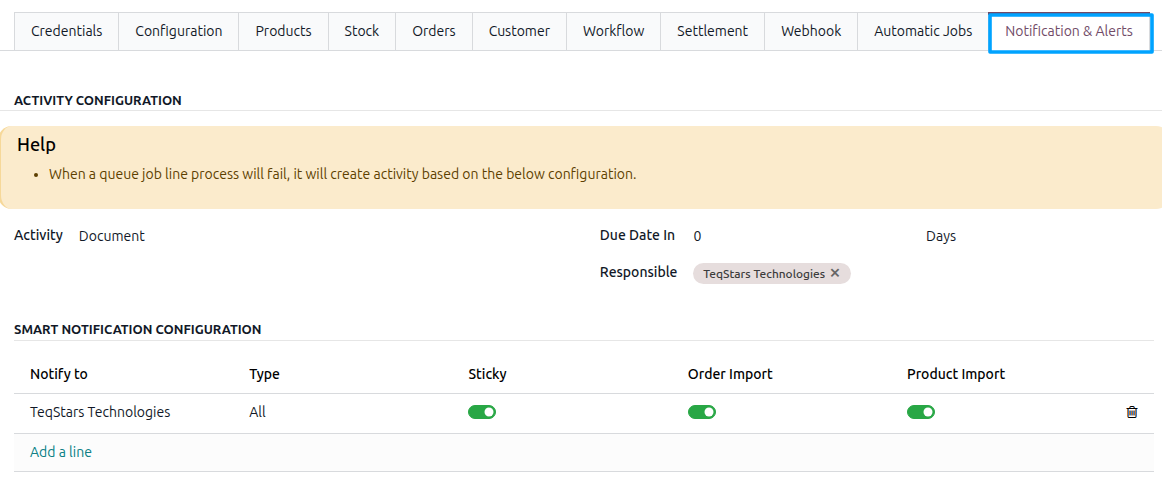
Activity Configuration
When a queue job line process fails, the system creates an activity based on the specified configuration.
By configuring Activity, Due Date In and Responsible the system can automatically generate an activity when a queue job line process fails. The activity will be assigned to the responsible person and categorized based on the specified type of activity. This helps ensure that appropriate follow-up actions are taken to address and resolve any issues or errors encountered during the Queue job process.
Smart Notification Configuration
By configuring Smart Notification Configuration, users will receive timely updates regarding the success or failure of order processing and product imports. This helps them stay informed and take appropriate actions promptly when needed.
Last Processed On
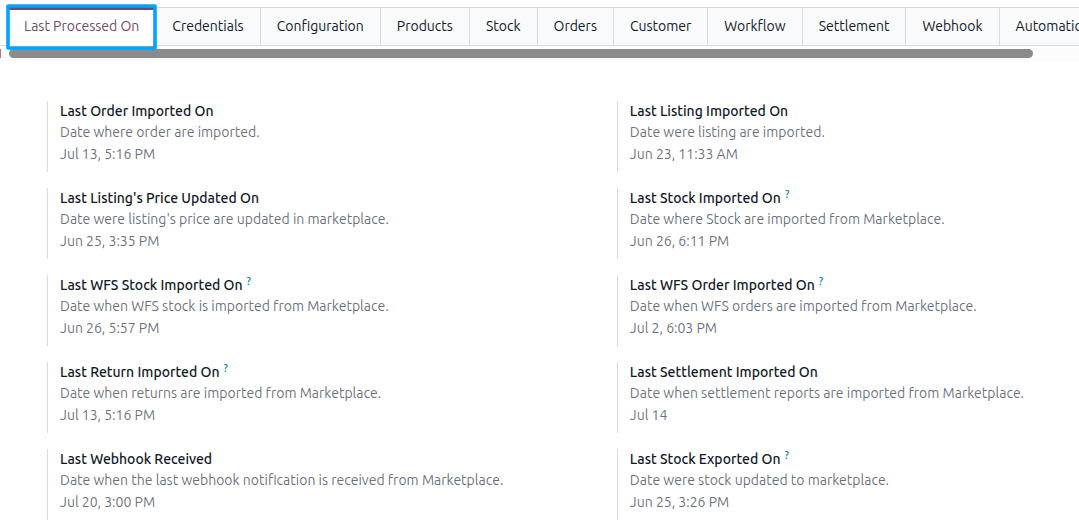
Last Processed On refers to the date that indicates the last time a specific operation or task was processed or executed. It typically represents the date and time of the most recent successful execution of a particular operation.
In most cases, the Last Processed On date is set when the Automatic Jobs are executed.
Alongside the standard dates, a Walmart instance shows:
Last WFS Stock Imported On: date when WFS stock is imported from Marketplace. Shown when the instance fulfills through WFS.
Last WFS Order Imported On: date when WFS orders are imported from Marketplace. Shown when the instance fulfills through WFS.
Last Return Imported On: date when returns are imported from Marketplace.
Last Settlement Imported On: date when settlement reports are imported from Marketplace. United States only.
Last Webhook Received: date when the last webhook notification is received from Marketplace. United States only.
Note
This tab appears once the instance has been saved and is no longer a draft.
Confirming Instance
Once you are satisfied with the configuration, click the
Confirmbutton. Upon pressing the Confirm button, your Walmart Odoo Instance will be confirmed.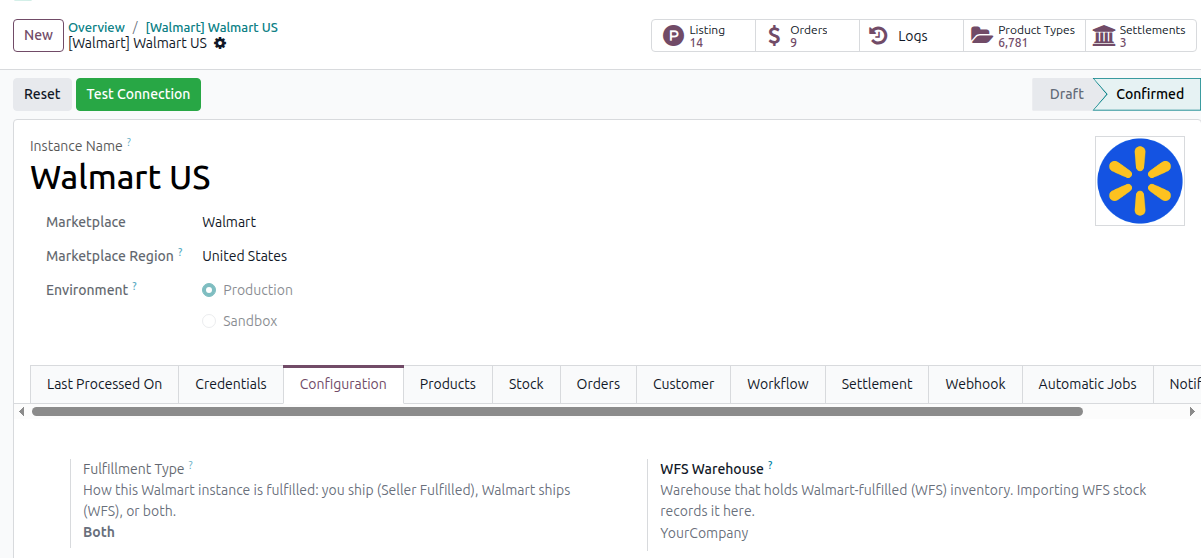
When confirming the instance for the first time, the connector performs the following actions automatically:
Import Ship Nodes: fetches your Walmart ship nodes and creates records in Odoo. See Walmart Ship Nodes.
Import the Product Type taxonomy (United States): fetches Walmart’s categories, product type groups and product types. See Import Walmart Product Types In Odoo.
Offers to fetch product type specifications (United States): a dialog appears so you can cache the specifications your listings need. Confirmation completes once you choose Fetch or Ignore & Confirm.
Sets the Pricelist: sets the pricelist matching the currency of the selected marketplace.
After confirmation the instance state is set to Confirmed and it is ready for operations. You can then
run the import and export operations from the Operations button on the instance: click it, choose
Import Operation or Export Operation, pick the operation you want, fill in any fields it shows, and
press PROCESS. Which operations appear depends on the marketplace and fulfillment type of the instance.