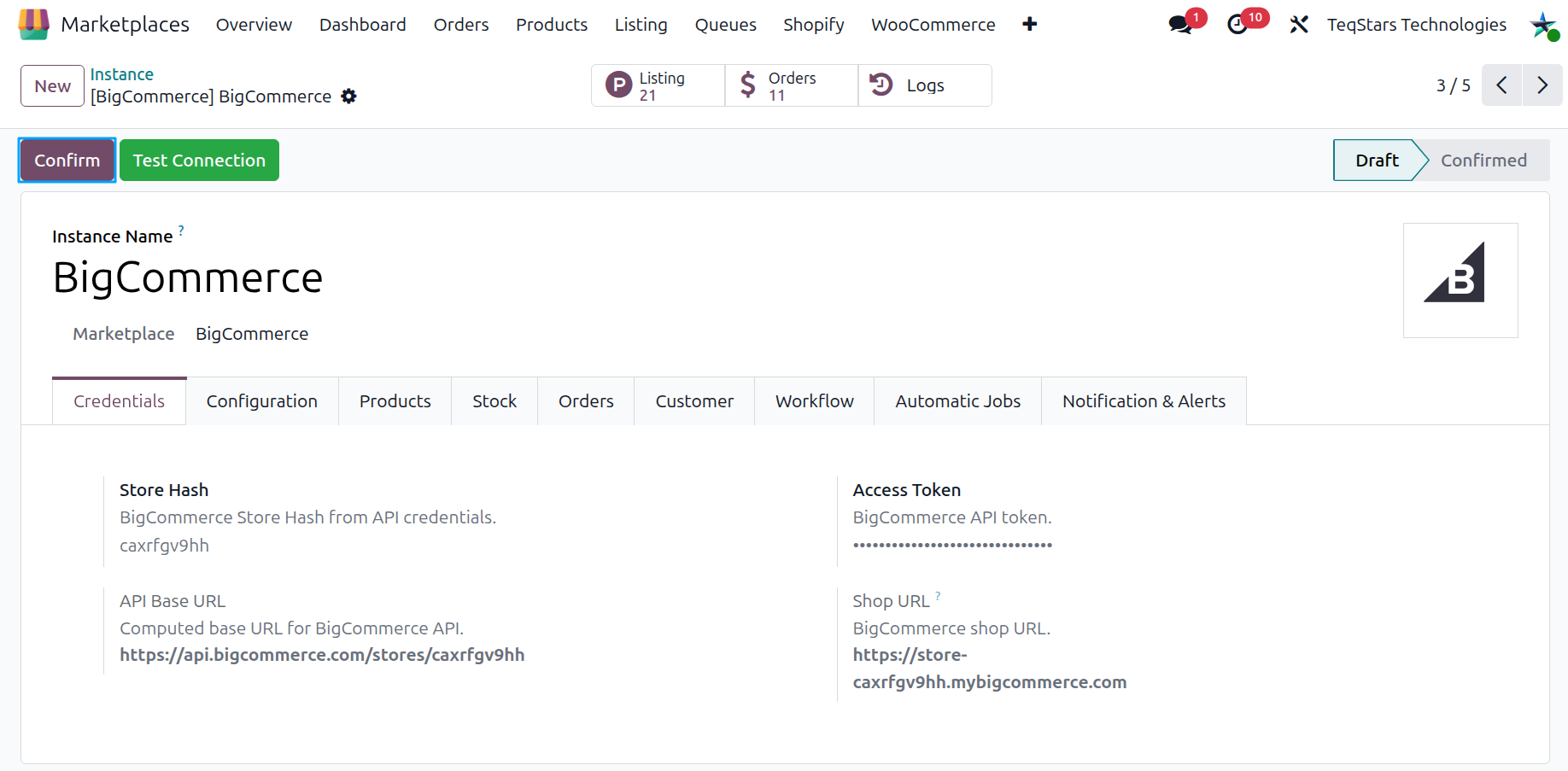
Create a BigCommerce instance in Odoo
To create your BigCommerce instance in Odoo, navigate to and click on New.
Choose a meaningful name for your Instance (for example
TeqStars BigCommerce) and set Marketplace toBigCommerce.On the Credentials tab, fill in the required BigCommerce API credentials (Store Hash and Access Token). Follow the Generate BigCommerce Credentials guide to create a Store API Account with the right OAuth scopes and connect your BigCommerce store to Odoo.
Let’s begin with the instance configuration process for the BigCommerce Odoo Connector. By following the configurations below you’ll be able to set up and customize the integration according to your business needs. The remaining sections describe each configuration group on the instance form, and the final Confirming the Instance section walks you through testing and confirming the connection.
Last Processed On
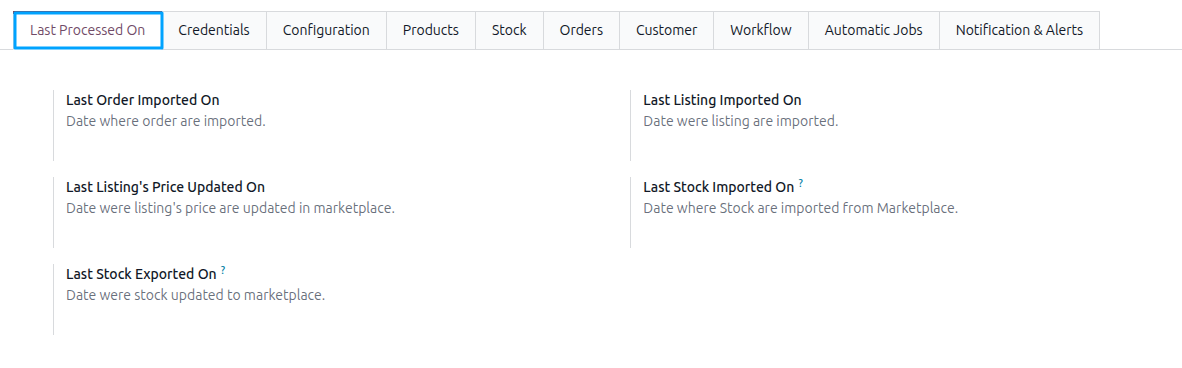
Last Processed On refers to date that indicates the last time a specific operation or task was processed or executed. It typically represents the date and time of the most recent successful execution of a particular operation.
In most cases, the Last Processed On date is set when the Automatic Jobs are executed.
Configurations
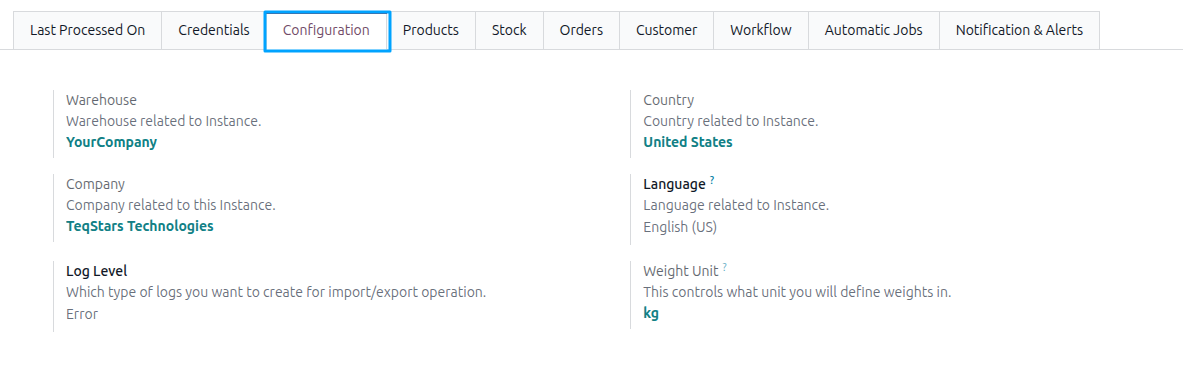
Under the Configuration tab, you can define the core operational settings for your BigCommerce instance:
Warehouse: Select the Odoo warehouse related to this instance. This warehouse will be utilized for stock operations and order processing for this marketplace.
Country: Select the country related to the instance (e.g., United States).
Company: Choose the company related to this instance.
Language: Select the language related to the instance (e.g., English (US)).
Log Level: Choose which type of log level you would like to have. You can choose between
ALL,SUCCESS, orERROR(defaultERROR). The system will create logs for each marketplace operation. To view the logs, navigate to .Queue Batch Limit: Default to
100records. We aren’t suggesting to change this.
Note
To modify the Queue Batch Limit, activate the developer mode and navigate to and click on the Configuration tab.
Product Configurations
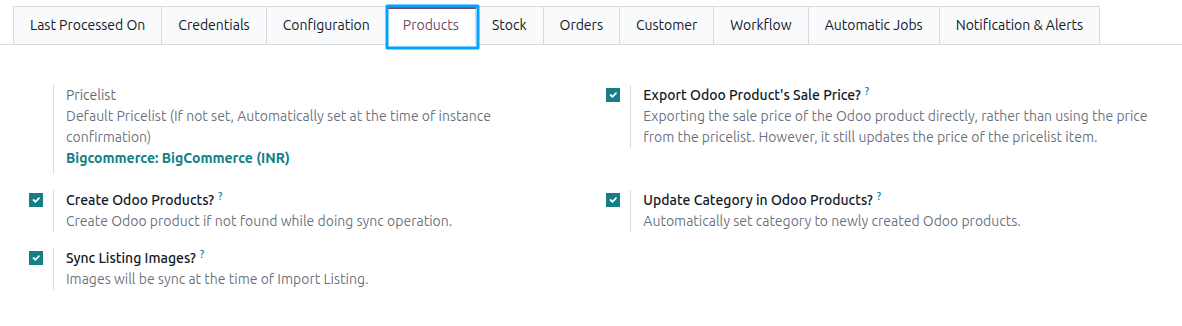
Pricelist
Pricelist refers to a pricing configuration that determines the prices of products during the product sync operation between BigCommerce and Odoo. When prices are imported or exported during synchronization, this pricelist is used to set the appropriate prices. When the order currency from BigCommerce matches the currency set in the pricelist during the import order operation, the pricelist is applied to the order in the Odoo ERP system.
Export Odoo Product’s Sale Price?
When exporting Odoo products, the standard behavior is to export the prices based on the pricelist configured on the instance. However, if you want to export the product’s sale price directly, bypassing the pricelist, you can enable this option to customize the export behavior.
Create Odoo Products?
Enabling Create Odoo Products? allows the BigCommerce Odoo Connector to automatically create new products in your Odoo catalog when no matching product is found by SKU during listing import. This streamlines the product synchronization process by ensuring that all products from your BigCommerce store are accurately represented in your Odoo ERP system.
Tip
If you already have existing products in your Odoo ERP system, it is not recommended to enable Create Odoo Products? on the instance.
Update Category in Odoo Products?
This ensures that when a new product is added to the Odoo ERP system, it is automatically set with the category received from BigCommerce. This keeps Odoo’s product categorisation aligned with BigCommerce’s category tree without manual intervention.
Sync Listing Images?
Images associated with products being imported from BigCommerce to Odoo will be synchronized and attached to the corresponding listing during the import operation. By syncing the listing images, the images are properly available and associated with the matching listings within the Odoo system.
Note
BigCommerce listings are matched to Odoo products by SKU. SKU is the standard matching key for BigCommerce, applied automatically by the connector — no extra configuration is required on the instance form.
Stock Configurations
Weight Unit
Mirrors the BigCommerce store’s weight measurement (
LBS,KGS,Ounces,Grams, orTonnes). The connector reads this from your BigCommerce store settings during instance confirmation and uses it to convert Odoo product weights when exporting or updating listings, so your BigCommerce store always receives weights in the unit it is configured to display.Stock Based On
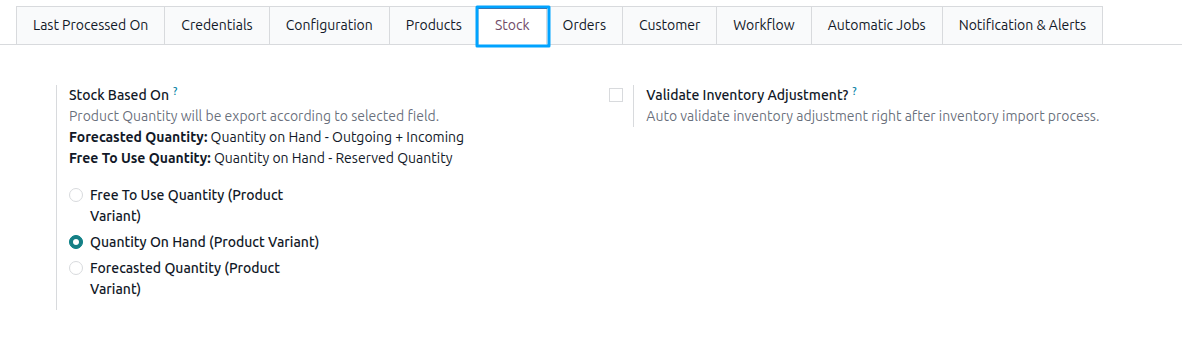
When exporting inventory from Odoo to BigCommerce, you can choose
Free To Use Quantity,Quantity On Hand, orForecasted Quantitybased on your requirements, ensuring accurate inventory management between BigCommerce and Odoo.Tip
Forecasted Quantity: Quantity on Hand - Outgoing + Incoming
Free To Use Quantity: Quantity on Hand - Reserved Quantity
Validate Inventory Adjustment?
The system automatically confirms the inventory adjustment after importing inventory data. By enabling Validate Inventory Adjustment?, the inventory adjustment created from the BigCommerce import is automatically marked as validated without requiring manual intervention.
Note
Two conditions must be met for an item to be included in Import Inventory:
The BigCommerce listing must have Inventory Tracking enabled on BigCommerce’s side (tracked at the product level or per variant). Listings whose BigCommerce setting is Inventory level will not be tracked are skipped because BigCommerce holds no stock for them.
The matched Odoo product must have Tracking = No Tracking. Products tracked by lot or serial number are skipped because BigCommerce returns aggregate quantities per location, with no lot or serial breakdown that Odoo could use to allocate the imported stock safely.
For per-location configuration (warehouse, stock location, enable toggle), see Configure BigCommerce Locations.
Orders Configurations
Order Status
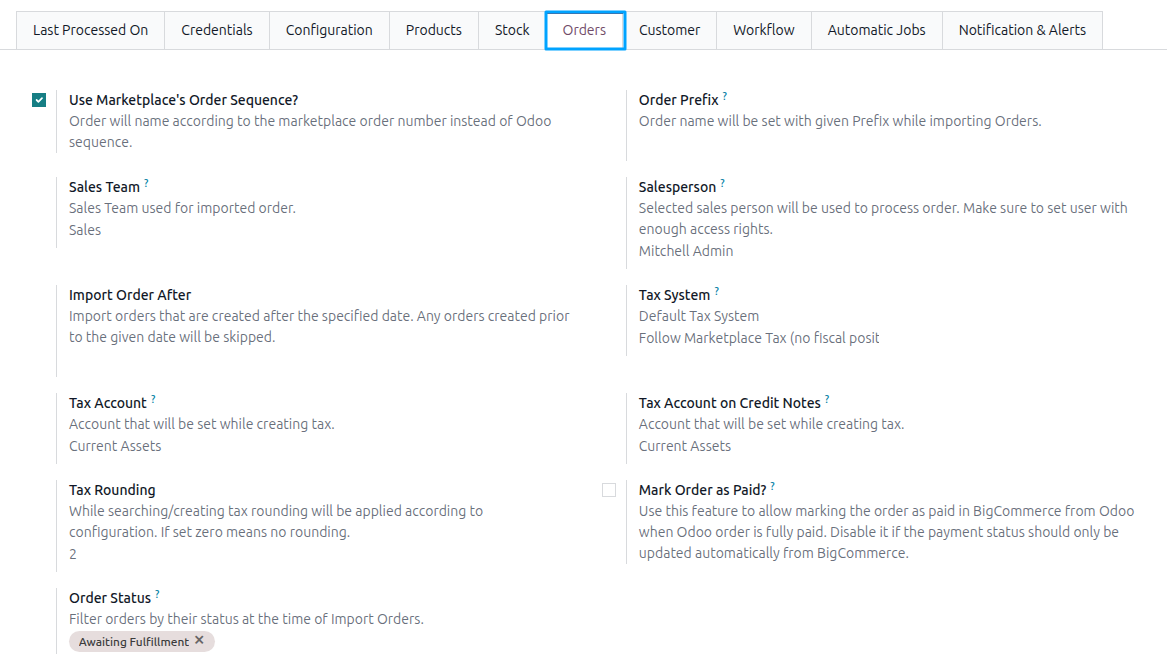
A multi-select list of BigCommerce order statuses that are eligible for import. The connector imports the full set of BigCommerce statuses into Odoo when the instance is confirmed and pre-selects
Awaiting
Fulfillment
. You can later add or remove statuses on this field to widen or narrow the import filter. Only orders whose BigCommerce status is in the selected list are picked up by Import Orders.Mark Order as Paid in BigCommerce?
When enabled, registering payment on an Odoo invoice (or clicking Mark As Paid In BigCommerce on the sale order) pushes a manual capture transaction to BigCommerce so the order shows as Paid in the BigCommerce control panel. This is useful for offline payments, such as bank transfers, cash on delivery, or any payment not captured by a BigCommerce payment gateway. See Mark As Paid Orders From Odoo To BigCommerce for the full flow and visibility rules.
Use Marketplace’s Order Sequence?
This feature allows you to name orders in Odoo based on the BigCommerce order number rather than using the default Odoo sequence. This ensures that the order names in Odoo correspond directly to the order numbers generated by the BigCommerce platform, providing consistency and easier cross-referencing between Odoo and BigCommerce.
Order Prefix
This feature allows you to specify a prefix that will be added to the names of imported orders. When importing orders from your BigCommerce store to your Odoo ERP system, the connector will automatically set the order name with the given prefix. This helps to easily identify and distinguish the imported orders in your Odoo system.
Sales Team
By configuring this feature, you can ensure that all imported orders from BigCommerce are automatically assigned to the specified default Sales Team in Odoo.
Salesperson
Select a salesperson who will be responsible for processing the orders received from your BigCommerce store. It is important to ensure that the assigned user has sufficient access rights in Odoo.
Tax System
The tax system on the BigCommerce Instance offers three options for handling taxes when importing orders from BigCommerce:
Odoo’s Default Tax Behaviour (Taxes will be taken from Odoo Product):
With this option selected, Odoo will use the tax information defined on the Odoo products and related fiscal rules. When importing orders from BigCommerce, the connector ignores BigCommerce tax lines and applies the taxes configured on the corresponding Odoo products. This keeps tax calculation fully aligned with your Odoo tax configuration.
Follow Marketplace Tax (no fiscal position mappings):
With this option, the connector follows the tax amounts coming from BigCommerce. For each tax on the BigCommerce order, Odoo looks for a matching tax; if it does not exist, a new tax can be created and linked to the configured Tax Account fields. The resulting Odoo taxes are applied directly on the order and shipping lines without applying any fiscal position mappings.
Follow Marketplace Tax and applies fiscal position mappings:
This option also starts from the taxes provided by BigCommerce, creating or reusing matching Odoo taxes as needed. After determining the Odoo taxes based on BigCommerce tax lines, the connector applies the fiscal position of the order to remap those taxes before posting them on the order lines. This lets you respect BigCommerce tax amounts while still using Odoo fiscal position rules for accounting and reporting.
Tax Account
Specifies the account associated with a tax when it is created in Odoo from a BigCommerce tax line. This account is used to record tax-related transactions and ensures accurate tracking and reporting of tax amounts within your Odoo ERP system. By setting the Tax Account, you make sure that taxes coming from BigCommerce are properly accounted for and integrated into your financial management processes.
Tax Account on Credit Notes
Specifies the account associated with a tax when a credit note is created in Odoo from a BigCommerce refund. This account is used to record tax-related transactions on credit notes and ensures accurate tracking and reporting of refund tax amounts within your Odoo ERP system.
Tax Rounding
When Tax Rounding is enabled and set to zero, no rounding will be applied. This feature ensures that tax calculations are accurate and aligned with your specific tax regulations and requirements. By configuring Tax Rounding according to your needs, you can maintain precision in tax calculations within the Odoo BigCommerce Connector.
Custom Product (Only visible in developer mode)
This feature allows for the seamless import of BigCommerce orders that contain custom (non-catalog) items into Odoo. These custom items, typically consumable products, are imported as separate products on the order in Odoo using the configured product.
Custom Storable Product (Only visible in developer mode)
BigCommerce orders that contain custom fulfillable (storable) items are imported using this product for those lines when no matching Odoo product is found.
Gift Certificate Product (Only visible in developer mode)
Allows the import of BigCommerce gift certificate amounts using a specific service-type product. When a BigCommerce order includes a gift certificate, the amount is imported into Odoo as a negative line using this product.
Delivery Product (Only visible in developer mode)
Defines the specific product in Odoo that represents the charges associated with the delivery of orders from your BigCommerce store. While creating a new delivery method, you can associate the Delivery Product with that particular method so the associated product is used to calculate and represent the delivery charges for orders using that delivery method.
Create Single Invoice? (Only visible in developer mode)
Determines whether a single invoice should be created once all items in an order are available for invoicing. When enabled (default), the invoice is generated only after all products are ready. When disabled, invoices can be created separately for each product as it becomes ready.
Customer Configurations

Receivable Account
This allows you to specify the default account for receivables when creating customers from BigCommerce orders. By setting this field to Account Receivable instead of the default account, you ensure that receivable transactions, such as invoices and payments, associated with the customer are correctly accounted for in the Odoo ERP system.
BigCommerce Create Company Contact?
When a contact is being created during order import, the connector checks if the BigCommerce billing address contains a company name. If found, it automatically generates a separate Company contact and links the individual contact to it as a child contact, ensuring that the company’s information is properly recorded and linked to the contact in Odoo. This feature is recommended for B2B stores where the same company places orders from multiple individuals.
Financial Workflow Configuration
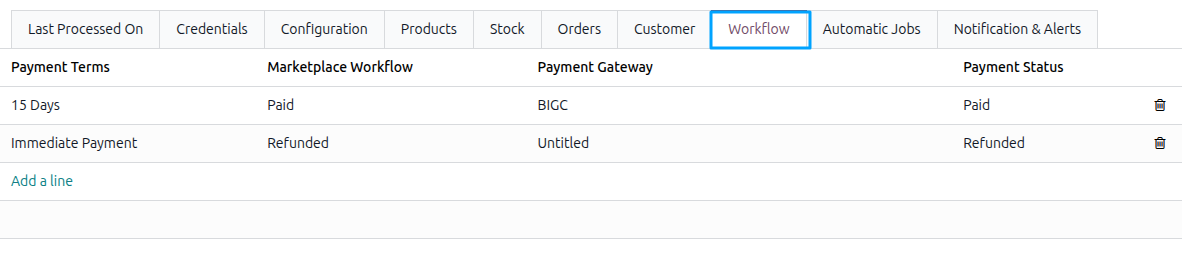
Workflow is a configuration setting used in the BigCommerce Odoo Connector that enables the automatic processing of orders from BigCommerce. This workflow automates various actions, including confirming orders, creating invoices, validating invoices, and registering payments.
By setting up the Marketplace Workflow, you can streamline the order processing cycle and save time by eliminating manual interventions. The workflow ensures that orders from BigCommerce are seamlessly processed and managed within your Odoo system.
Payment Terms
Payment Terms are set on the order at the time of creation and specify when and how the customer is expected to make the payment for their purchase.
Marketplace Workflow
It enables the automatic processing of orders from BigCommerce. This workflow automates various steps, including confirming orders, creating invoices, validating invoices, and registering payments.
To learn more about the details and configuration options of the Marketplace Workflow, please refer to the following link: Configure Marketplace Order Workflow.
Payment Gateways & Payment Status
The order workflow can be defined based on the combination of the Payment Gateway used for the transaction and the Payment Status of the order on BigCommerce.
Different Payment Gateways may have specific requirements or processes for handling payments and updating the Payment Status in Odoo.
The order processing is triggered based on the Payment Status received from the Payment Gateway.
By considering the Payment Terms, Payment Gateway, and Payment Status of an order, businesses can define an appropriate workflow that ensures smooth order processing and accurate payment handling.
Note
The Payment Gateway and Payment Status values are read from each BigCommerce order during import. If a gateway sent by BigCommerce is not yet listed in , the connector creates it automatically the first time it is encountered, so you only need to fill in the workflow line for the new gateway.
Automatic Jobs Configurations
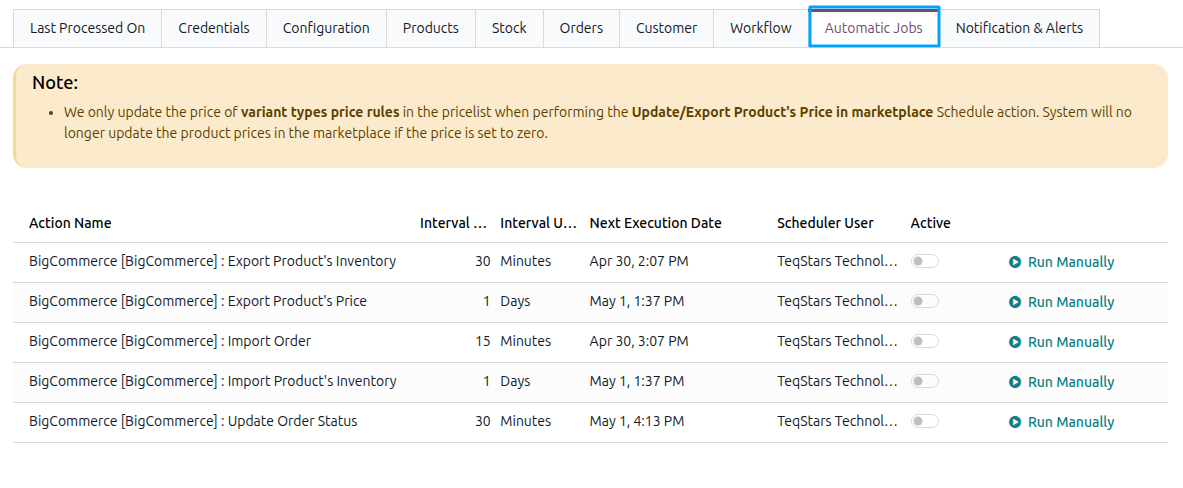
Automatic Jobs Configurations allow for the automation of various tasks related to exporting and importing data between BigCommerce and Odoo. These jobs are scheduled to run automatically at specified intervals to keep the data synchronized and up to date. You can configure Interval Number, Interval Unit, and Active for each job. Here’s an explanation of each automatic job.
Import Order
With this configuration, the connector automatically imports new orders from BigCommerce to Odoo.
It ensures that the orders placed by customers on your BigCommerce store are seamlessly transferred to Odoo for further processing and fulfillment.
Order configuration and Workflow configuration will be used while importing and processing orders.
Export Order Status/Tracking Information
This automatic job enables the automatic export of order status and tracking information from Odoo to BigCommerce.
It ensures that order updates, such as shipment status and tracking numbers, are reflected accurately in BigCommerce.
Import Product’s Inventory
With this automatic job, the connector automatically imports the inventory levels of products from BigCommerce to Odoo.
It keeps the inventory data synchronized, ensuring that the stock levels in Odoo reflect the actual stock available on BigCommerce.
Validate Inventory Adjustment? configuration will be used while importing product’s inventory.
Export Product’s Inventory
This automatic job exports the inventory levels of products from Odoo to BigCommerce.
It helps keep the product stock information synchronized between the two platforms, ensuring accurate stock availability on your BigCommerce store.
Stock Based On configuration will be used while exporting stock.
Export Product’s Price
This automatic job enables the automatic export of product prices from Odoo to BigCommerce.
Any changes in product prices in Odoo are automatically reflected in the corresponding products on BigCommerce.
Pricelist will be used while exporting price to BigCommerce.
Note
It’s important not to schedule all your jobs to run at the same time interval because it can consume a significant amount of your system resources. Instead, it’s recommended to leave a gap between them. This helps ensure that your system resources are not over-used and can handle the workload more efficiently.
Notification & Alerts
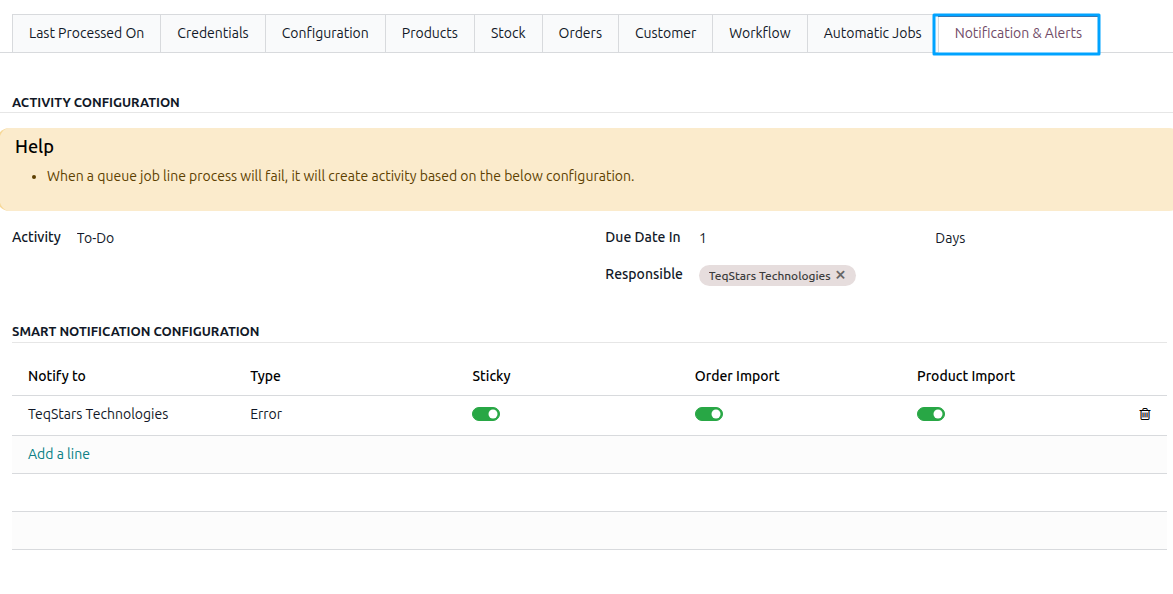
Activity Configuration
When a queue job line process fails, the system creates an activity based on the specified configuration. By configuring Activity, Due Date In, and Responsible, the system can automatically generate an activity for the responsible person whenever a queue line fails. This helps ensure that appropriate follow-up actions are taken to address and resolve any issues or errors encountered during the queue processing.
Smart Notification Configuration
By configuring Smart Notification, users will receive timely email updates about the success or failure of order processing and product imports. Each operation sends a summary notification with success counts and error counts, helping the configured recipients stay informed and take prompt action when something needs attention.
Confirming the Instance
Click Test Connection first to verify the Store Hash and Access Token are valid. On success, Odoo displays a confirmation banner.
Once the form is filled in and the connection has been tested, click Confirm. The connector:
Imports the store currency and configures the pricelist accordingly.
Imports the store’s weight unit.
Imports BigCommerce order statuses and pre-selects
Awaiting Fulfillmentin the Order Status field.Imports Sales Channels, Locations, and Tax Classes.
Starts background threads to import Categories and Brands.
Sets the instance state to Confirmed.